Indigenous Peoples and the Mineral Footprint of Artificial Intelligence
By Bryan Bixcul (Maya-Tz’utujil) SIRGE Coalition, Nalori Chakma (Chakma) Tallgrass Institute
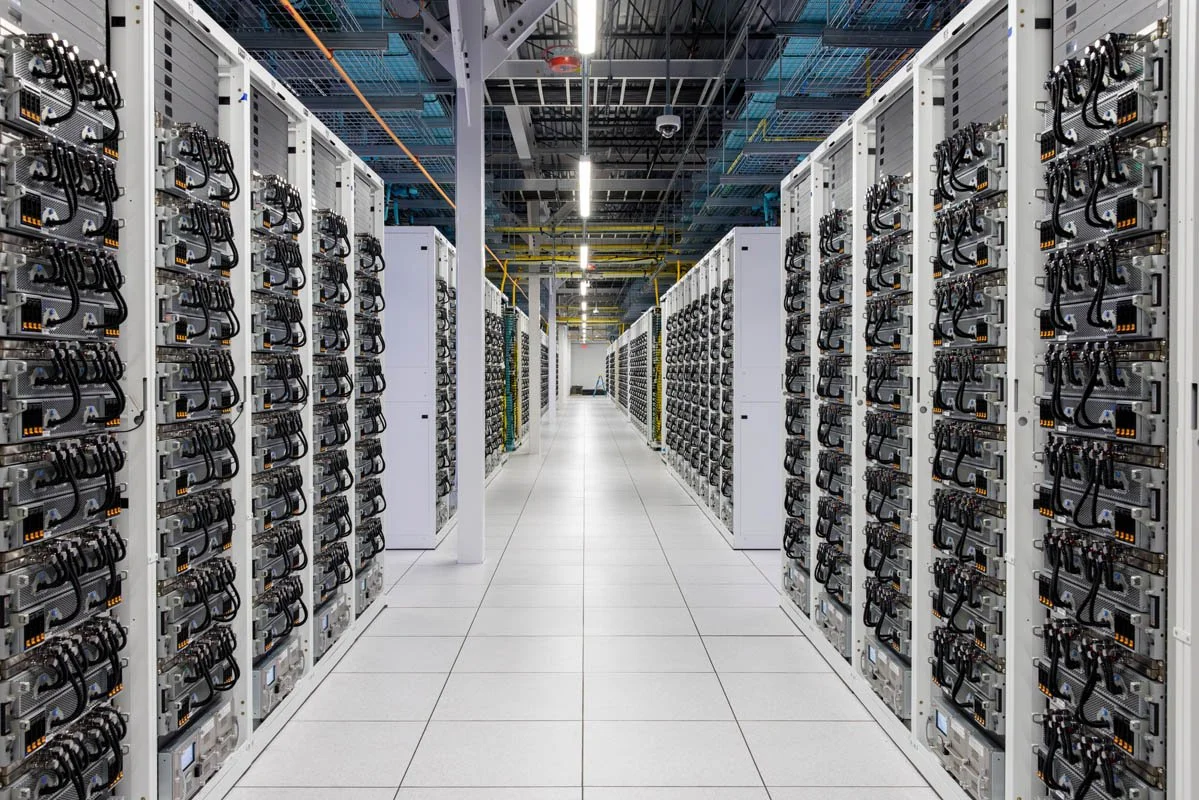
Colossus, xAI's massive artificial intelligence supercomputer and data center complex located in Memphis, Tennessee.
The world is experiencing a rapid digital transition, driven by the development and global adoption of Artificial Intelligence (AI) and other digital technologies. This transition is enabled by a massive expansion of data center infrastructure, followed by an even bigger buildout of electricity systems required to power energy-hungry AI data centers.
Artificial Intelligence may appear immaterial to its users, as an amorphous construct that exists “in the cloud.” But the cloud is not a cloud. It is a physical system built from land, water, electricity, data centers, chips, minerals, cables, and semi-conductor supply chains. Its impacts are material and are often felt far from places where AI is marketed and used.
The rapid and unevenly regulated development of AI systems creates multiple layers of risk for Indigenous Peoples, from mineral extraction and water depletion to concerns involving Indigenous Data Sovereignty, intellectual property, surveillance, and exclusion from decision-making. AI can be a useful tool, but its impacts depend on who controls its development, who bears its costs, and whether Indigenous Peoples have the authority to say yes, say no, or determine the conditions under which AI-related infrastructure is built, data is used, and resources are extracted.
AI’s physical footprint is becoming increasingly visible in the energy system. In the United States, a major hub for AI infrastructure, rising demand from data centers, domestic manufacturing, and electrification is contributing to a period of growing electricity demand. The Electric Power Research Institute (EPRI) has estimated that data centers could consume between 9% - 17% of U.S. electricity generation annually by 2030, compared with 4% in 2023. AI is not the sole driver of this growth, but it is one of the clearest examples of how digital technologies depend on expanding systems of electricity, water, land, minerals, and infrastructure.
The money behind this transition is staggering. Stanford’s AI index reported that corporate AI investments reached $252.3 billion in 2024, with the sector growing more than thirteenfold since 2014. But these figures are not only about technology. They point to a much larger reorganization of infrastructure, capital, energy demand, and political power. Whether this transformation benefits Indigenous Peoples and our ecosystems, or deepens existing patterns of extraction inequality, depends on the safeguards, accountability mechanisms and decision-making power built into it from the start.
This article argues that AI is placing two interconnected pressures on Indigenous Peoples. Its rapid expansion is increasing demands for minerals, energy, and infrastructure, much of which affects Indigenous Peoples’ lands and territories. At the same time, AI is being used by mining companies to identify mineral deposits and accelerate exploration, including through data relating to those same territories. Understanding AI’s impacts therefore requires examining not only the infrastructure that supports it, but also how the technology is reshaping mineral exploration, access to land, and control over Indigenous Peoples’ data.
How AI’s Material Footprint Reaches Indigenous Peoples’ Lands
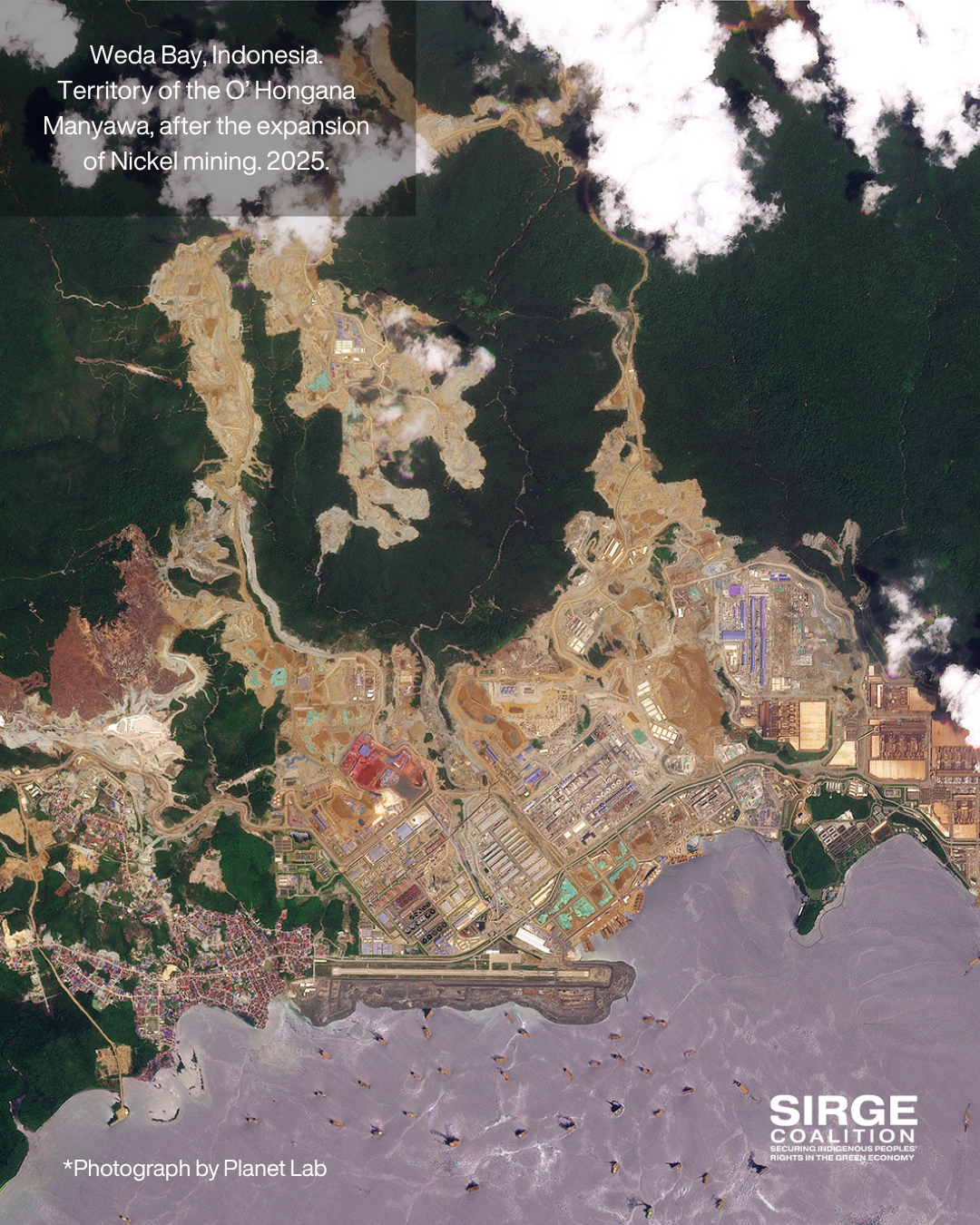
Indigenous Peoples’ lands and territories are the basis of governance systems, cultural identity, food systems, and relationships with ecosystems and future generations. The expansion of AI-linked infrastructure, whether through mining, energy generation, transmission corridors, or data centers, therefore, raises deeper questions beyond data centers around Indigenous Peoples’ land rights. It raises questions of jurisdiction, authority, and the ability of Indigenous Peoples to exercise their rights over their territories.
From our perspective, AI technologies expose Indigenous Peoples to multiple overlapping risks. These include the expansion of mineral extraction and energy infrastructure on or near Indigenous Peoples’ lands, as well as water and land-use changes associated with data centers and electricity generation. They also include the extraction or misuse of Indigenous data, language, cultural materials and knowledge systems without Free, Prior and Informed Consent (FPIC), and the use of AI enabled tools for surveillance, policing, or monitoring of Indigenous activists and movements.
These risks are connected through a development model that often assumes lands, resources, data, and knowledge can be taken, processed, and monetized before Indigenous Peoples have had the opportunity to decide whether, how, or on what terms this should occur. AI is not neutral: it reflects the priorities and power of those who design, finance, deploy, and profit from it. Its expansion is often presented as inevitable rather than as a political and economic project that should be debated, governed, and constrained.
Yet these priorities are not necessarily shared by the broader public. A 2026 Gallup poll found that 71% of people in the United States oppose the construction of AI data centers in their local area, citing concerns including electricity, water consumption, environmental impacts, and pressures on local infrastructure. These findings suggest that AI is increasingly becoming a contested political, social, and environmental issue. Despite this, public debate has largely focused on the visible impacts of AI infrastructure, while the upstream impacts associated with the extractive systems on which AI depends remain largely overlooked.
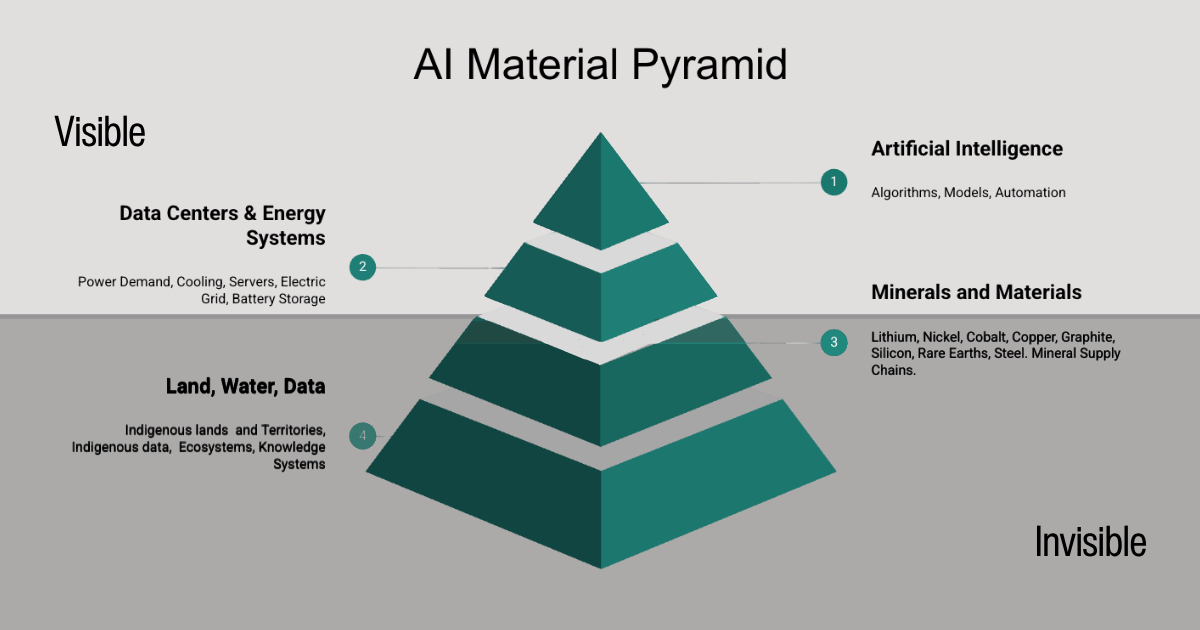
AI Material Pyramid. Source: Author's own elaboration.
In many jurisdictions, decisions about land allocation are made through permitting, zoning, or investment frameworks that do not adequately recognize Indigenous land tenure or collective land rights, or Indigenous governance systems. AI’s material footprint therefore risks reproducing a familiar pattern: lands are treated as available for development, while Indigenous Peoples are treated as stakeholders to be consulted after key decisions have already been made.
The expansion of AI infrastructure does not occur in isolation, It overlaps with existing and growing demands from the energy transition, extractive industries, and large-scale infrastructure projects producing layered and cumulative impacts on the same territories. This is why safeguards around AI systems can and should be developed, but they are currently advancing far more slowly than the technologies and infrastructure they are intended to govern. Voluntary technology-ethics principles are insufficient where AI-linked supply chains affect Indigenous lands, waters, data, knowledge, and self-determination. Our lived experience shows what happens when development is described as progress while affected Peoples are expected to absorb its costs without their consent. AI governance must not repeat that pattern.
The Mineral Footprint Extends Beyond Semiconductors

“Semiconductors rely on silicon, gallium, germanium, indium, tantalum, and gold. Electricity generation and transmission depend on copper, aluminum, iron, zinc, and electrical steel. Data centers require copper, aluminum, silver, and rare earths. Energy storage systems rely on lithium, graphite, nickel, cobalt, and manganese. This is not an exhaustive list, but it shows that AI’s footprint spans multiple mineral supply chains.”
A central dimension of AI’s material footprint is its dependence on minerals and raw materials. AI systems rely on complex physical infrastructure that includes semiconductor manufacturing, computing hardware, data centers, power generation and transmission systems, cooling infrastructure and in some cases, battery energy storage systems (BESS). These components perform different functions, but all depend on mineral-intensive supply chains.
Semiconductor manufacturing relies on silicon, gallium, germanium, indium, tantalum, and gold. Electricity generation and transmission depend heavily on copper, aluminum, iron, zinc, and electrical steel. Data centers, networking equipment, and cooling systems require substantial quantities of copper, aluminum, silver, rare earth elements, and other metals. Energy storage systems rely on lithium, graphite, nickel, cobalt, and manganese. This is not an exhaustive list, but it shows that AI’s footprint spans multiple mineral supply chains.
One 2026 study suggests that copper accounts for the largest share of AI’s mineral footprint, around 83%, reflecting its central role in electricity generation, transmission, and data center infrastructure. While other minerals may represent smaller shares by mass, many are already subject to supply constraints. As a result, even marginal increases in demand are likely to translate into new extraction. This is particularly important in the context of Indigenous Peoples’ lands, where over half of transition mineral projects are located.
At the same time, Battery Energy Storage Systems (BESS) are an increasingly critical component of AI infrastructure. These systems store electricity and release it when needed, supporting peak demand, back-up power and the integration of renewable energy. Most commercial BESS rely on lithium-ion batteries, which require minerals such as lithium, graphite, copper, aluminum, nickel, cobalt, manganese, among others. Tech companies are increasingly deploying BESS as a key component of AI data center infrastructure. One example of this trend is AirTrunk, which has announced plans to deploy a grid-scale BESS alongside its hyperscale data center in Australia.
Many of the minerals required for AI infrastructure are also important to renewable energy, grid expansion, electrification, and electric vehicles. These sectors therefore draw on overlapping mineral value chains. Additional demand for AI may increase pressure to expand existing operations and develop new mining projects, particularly where recycling, substitution, and material efficiency measures cannot meet demand at the required scale.
This pressure has particular implications for Indigenous Peoples. A study of 5,097 energy transition mineral projects found that 54% were located on or near Indigenous Peoples’ lands. As AI adds demands across many mineral value chains, AI governance cannot stop at data centers or algorithms. It must also address the conditions under which minerals are extracted and recognize Indigenous Peoples as rights holders with authority over decisions affecting their lands, territories, and resources.
AI’s Energy Demand Adds Pressure to the Transition

“Through 2030, data centers are projected to account for nearly half of the country’s electricity-demand growth.
Without the displacement of existing fossil-fuel generation, this buildout risks reinforcing a pattern of energy addition rather than delivering an energy transition.”
AI focused data centers require large and reliable supplies of electricity. The International Energy Agency reports that a typical AI-focused data center can consume as much electricity as 100,000 households, while the largest facilities under construction may consume many times more. Globally, electricity consumption from data centers is projected to rise from approximately 415 terawatt-hours in 2024 to around 945 terawatt-hours by 2030. AI is the most important driver of this increase, alongside continued growth in cloud computing and other digital services.
The United States accounted for approximately 45 percent of global data-center electricity consumption in 2024. Through 2030, data centers are projected to account for nearly half of the country’s electricity-demand growth. Renewables are expected to meet a substantial share of additional global data-center demand, but natural gas and other dispatchable sources are also projected to expand.
Without the displacement of existing fossil-fuel generation, this buildout risks reinforcing a pattern of energy addition rather than delivering an energy transition. Renewable and fossil-fuel infrastructure alike requires land, transmission corridors, and mineral extraction. Where new electricity systems and related infrastructure affect Indigenous lands and territories, they must be governed through Indigenous Peoples’ rights, including land rights, participation through their own representative institutions, and Free, Prior and Informed Consent.
When AI Speeds Up Mineral Extraction
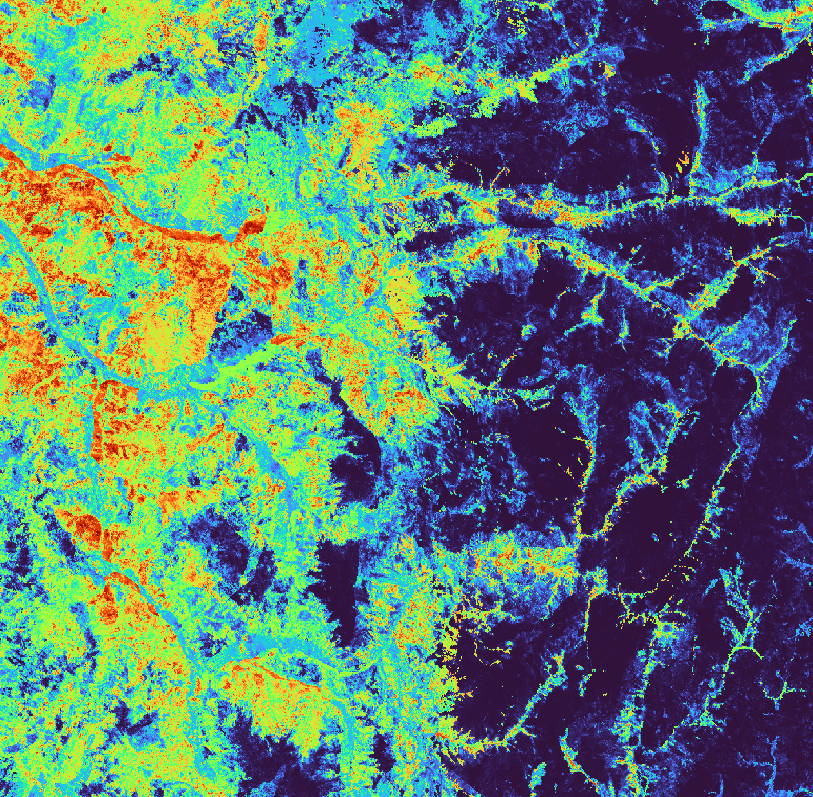
Raw predictive output of mineral distribution. Image: MinersAI.
The expansion of AI is increasing demand for transition minerals, while AI systems are also being used to locate them. AI-enabled exploration combines geological, geophysical, geochemical, and satellite data to estimate where deposits may be found and to guide decisions about where to survey or drill. Companies present these technologies as a way to make mineral exploration faster, cheaper, and more precise.
KoBold Metals is one of the most prominent examples. The company says that it combines AI, data systems, predictive models, novel sensors, and human expertise to inform mineral exploration. It identifies the Mingomba copper deposit in Zambia as its first discovery and is developing the site as a major copper project. The project is expected to enter production in the early 2030s, and, if developed as planned, produce approximately 300,000 tonnes of copper annually.
KoBold’s financing is also relevant. Its investors include Sam Altman’s Apollo Projects, the Silicon Valley venture capital firm Andreessen Horowitz, and Breakthrough Energy Ventures, a fund founded by Bill Gates whose investors include Jeff Bezos, Michael Bloomberg, Ray Dalio, Richard Branson, Jack Ma, and Vinod Khosla. These financial links do not, by themselves, demonstrate a coordinated attempt by the AI industry to control mineral supplies. They do, however, show a growing convergence between technology capital, data-intensive mineral exploration, and the resources required for computing, batteries, and energy infrastructure. This represents a second dimension of AI’s mineral footprint: AI contributes to mineral demand while AI-enabled systems are also being used to search for and develop new deposits.
Indigenous Authority over Territorial Data
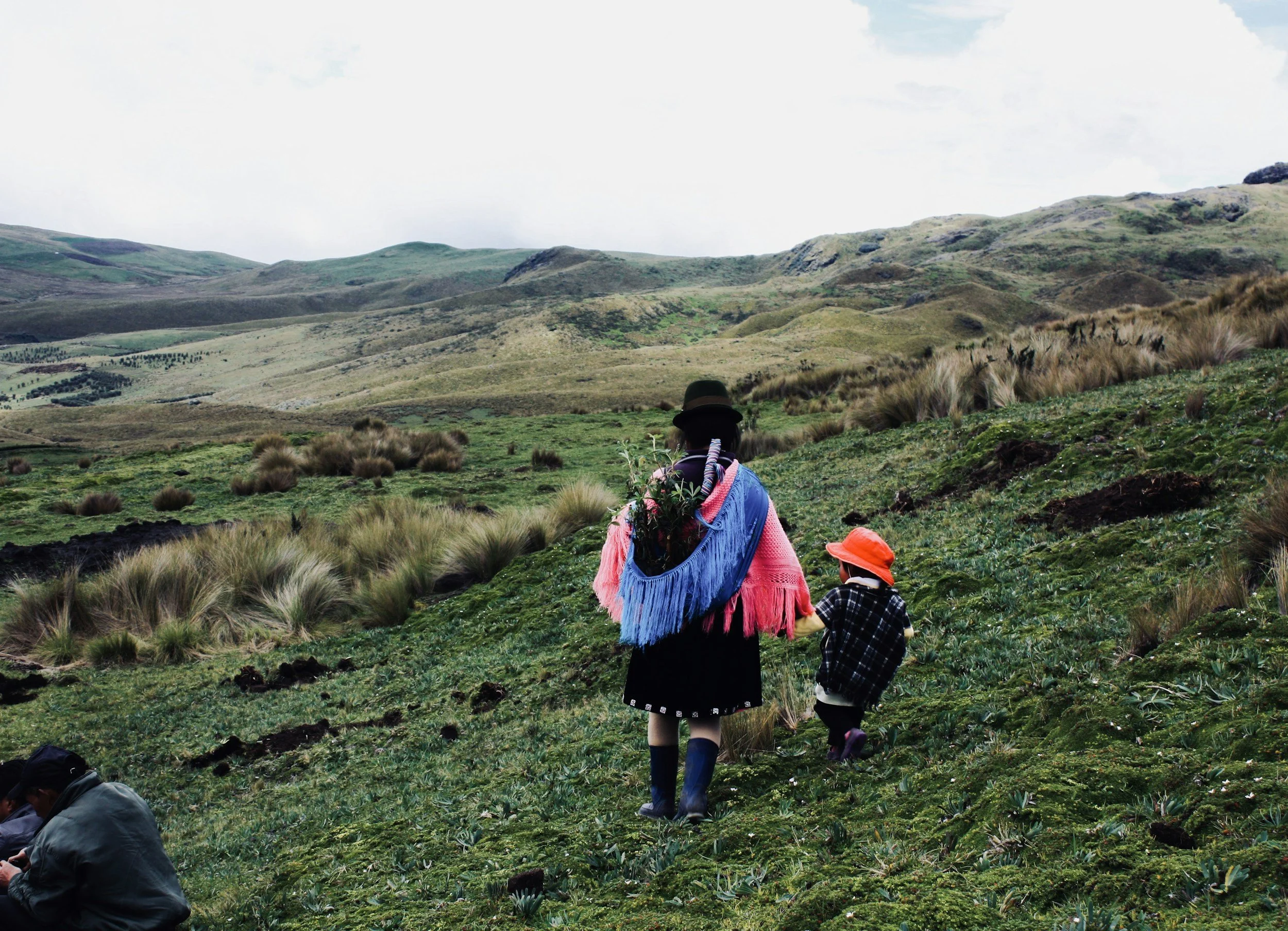
"Indigenous Peoples have the right to Indigenous data sovereignty and Indigenous governance in respect of Indigenous data as an expression of their inherent sovereignty and overarching right to Self-determination."
AI-enabled mineral exploration depends not only on access to land and minerals, but also on access to the data used to locate deposits. KoBold, for example, describes a system that organizes information from reports, legacy maps, handwritten notes, and geophysical and geochemical datasets into a standardized and searchable form. The capacity to combine and analyze such information raises important questions about who has the authority to collect, integrate, interpret, and use data relating to Indigenous Peoples’ lands, territories, and resources.
Articles 3, 18, 26 and 32 of the UN Declaration on the Rights of Indigenous Peoples provide an important framework for addressing these questions. Together, they recognize Indigenous Peoples right to self-determination, to participate in decision-making through their own representative institutions; to their lands, territories, and resources; and to Free, Prior and Informed Consent before the approval of projects affecting those lands, territories, and resources.
Building on these standards, the Expert Mechanism on the Rights of Indigenous Peoples (EMRIP) examined Indigenous Data Sovereignty in its 2025 study on the right of Indigenous Peoples to data. In paragraph 2, EMRIP states that "Indigenous Peoples have the right to Indigenous data sovereignty and Indigenous governance in respect of Indigenous data as an expression of their inherent sovereignty and overarching right to self-determination." It further explains in paragraph 66 that "Indigenous data governance is the right of Indigenous Peoples to autonomously decide what, how and why Indigenous data are collected, accessed and used." Paragraph 67 further clarifies that this includes "the use of data by data technologies, including deductive and generative artificial intelligence systems."
This guidance is critically important, because some AI-powered mineral exploration companies have stated goals of “building a Google Maps for the earth’s crust.” Achieving this would require collecting and using data from Indigenous lands. In these cases, it is essential that the collection, digitization, and integration of data related to Indigenous Peoples lands is governed by Indigenous Data Governance principles and carried out with the Free, Prior, and Informed Consent of the Indigenous Peoples concerned. This is especially relevant as some AI-driven exploration initiatives aim to build large-scale, global geological datasets.
Without proper safeguards, these efforts risk using data from Indigenous lands without consent, which could enable or accelerate extraction activities without the knowledge or approval of Indigenous Peoples. This is even more urgent in the case of Indigenous Peoples in Voluntary Isolation and Initial Contact (IPVIIC), where the discovery of mineral deposits in their lands through AI-powered technologies can put them at serious risks.
Efficiency for Whom?

“Efficiency toward what end?
Is the objective to reduce unnecessary extraction and ecological harm, or to identify mineral deposits more quickly and extract more minerals at greater speed and scale?”
Claims that AI will make mining more efficient should be examined carefully. AI-powered mining companies often point to faster deposit identification, lower exploration costs, shorter exploration timelines, improved ore recovery, and more efficient operations. But efficiency toward what end? Is the objective to reduce unnecessary extraction and ecological harm, or to identify mineral deposits more quickly and extract more minerals at greater speed and scale? Given the growing global demand for critical minerals, the latter is a legitimate concern.
Claims that AI-powered mining will be more ethical or sustainable should therefore not be accepted at face value. Whether these claims hold true will depend on whether AI is deployed in ways that respect the rights of Indigenous Peoples, including the rights to self-determination; Free, Prior, and Informed Consent; and Indigenous Data Sovereignty before collecting and using data relating to Indigenous Peoples and their lands, and before infrastructure projects proceed. It will also depend on whether these technologies contribute to protecting or harming the integrity of ecosystems, waters, lands, and territories affected by its supply chains.
AI Governance Must Begin with Indigenous Peoples’ Rights
“AI is often presented as a digital revolution, but its foundations are material. They are connected to lands, territories, waters, ecosystems, knowledge systems, and rights that have long been placed under pressure by extractive development.”
AI is often presented as a digital revolution, but its foundations are material. It depends on land, water, energy, minerals, data centers, semiconductors, batteries, transmission systems, and extractive supply chains. For Indigenous Peoples, these systems are not abstract. They are connected to lands, territories, waters, ecosystems, knowledge systems, and rights that have long been placed under pressure by extractive development.
The expansion of AI therefore cannot be governed only through technology ethics, data protection, or innovation policy. It must also be governed through Indigenous Peoples’ rights, including the rights to self-determination, lands, territories and resources, Indigenous data sovereignty, and Free, Prior and Informed Consent. These rights must apply not only to the use of Indigenous data and knowledge, but also to the infrastructure, energy systems, and mineral extraction that make AI possible.
This requires a broader understanding of AI accountability. Companies and governments benefiting from AI must be able to trace where the minerals, energy, land, and data behind these technologies come from, under what conditions they are obtained, and whether Indigenous Peoples’ rights have been respected. Safeguards must move beyond voluntary commitments and ensure meaningful participation, independent verification, remedy, and consequences where rights are violated.
Recognizing the risks associated with AI doesn’t mean that it has no possible value for Indigenous Peoples. AI may support Indigenous-led priorities, including language revitalization, mapping, biodiversity monitoring, archiving, and knowledge protection. However, these potential benefits do not resolve the deeper questions of consent, control, accountability, and authority over how these technologies are developed and used. Moreover, they shouldn’t justify another wave of extraction without Indigenous Peoples’ consent.
The question is not only how AI can be made more efficient or sustainable, but whether it can be governed in a way that respects Indigenous Peoples’ authority, protects ecosystems, and allows communities to decide whether, how, and on what terms these technologies affect their lands, waters, data, and futures.
About the authors:

Bryan Bixcul is the Director of Advocacy and Partnerships for the SIRGE Coalition secretariat. Bryan is a Maya-Tz’utujil from Tz’unun Ya’ in Guatemala. He is an Indigenous rights advocate working on policy and corporate accountability to support implementation of Indigenous Peoples’ rights globally.

Nalori Chakma is the Transition Minerals Advocacy Manager at Tallgrass Institute. She belongs to the Chakma tribe from Northeast India, she specializes in advancing Indigenous Peoples’ rights in the green energy transition, with a focus on Free, Prior and Informed Consent, Self-determination of Indigenous Peoples in the mineral value chain.
Disclaimer: The views expressed in this article are solely those of the authors and do not represent the views of the SIRGE Coalition, its members, or the Tallgrass Institute.
